


Menu
Menu
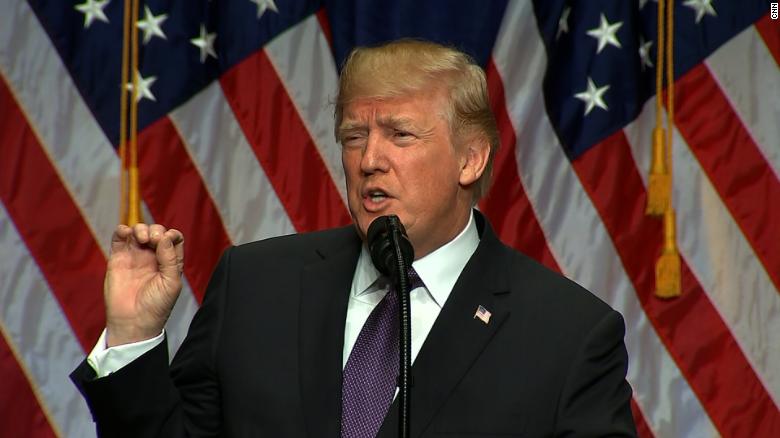
President Trump presented a blueprint for the country’s national security on Monday that warns of a treacherous world in which the United States faces rising threats from an emboldened Russia and China, as well as from what it calls rogue governments, like North Korea and Iran.
To fend off these multiple challenges, the report says with Cold War urgency, the government must put “America First,” fortifying its borders, ripping up unfair trade agreements and rebuilding its military might.
But in his speech announcing the strategy, Mr. Trump struck a much different tone. Instead of explaining the nature of these threats, he delivered a campaignlike address, with familiar calls to build a wall along the southern border with Mexico and a heavy dose of self-congratulation for the bull market, the low jobless rate and tax cuts, which, he promised, were “days away.”
“America is in the game, and America is going to win,” he said, to an audience that included cabinet members and military officers.
The disconnect between the president’s speech and the analysis in his administration’s document attests to the broader challenge his national security advisers have faced, as they have struggled to develop an intellectual framework that encompasses Mr. Trump’s unpredictable, domestically driven and Twitter-fueled approach to foreign policy. The same confusion has confronted foreign governments trying to understand Mr. Trump’s conflicting signals.
Mr. Trump, for example, spoke of how Russia and China “seek to challenge American influence, values and wealth.” But he made no mention of Russian interference in the 2016 presidential election, even though the document itself makes fleeting reference to “Russia using tools in an attempt to undermine the legitimacy of democracies.”
Indeed, Mr. Trump preferred to focus on a Sunday phone call from President Vladimir V. Putin of Russia, who thanked him for intelligence that the C.I.A. had passed on to Russian authorities, which Mr. Trump said foiled a terrorist attack in St. Petersburg that could have killed thousands of peopl
President Trump presented a blueprint for the country’s national security on Monday that warns of a treacherous world in which the United States faces rising threats from an emboldened Russia and China, as well as from what it calls rogue governments, like North Korea and Iran.
To fend off these multiple challenges, the report says with Cold War urgency, the government must put “America First,” fortifying its borders, ripping up unfair trade agreements and rebuilding its military might.
But in his speech announcing the strategy, Mr. Trump struck a much different tone. Instead of explaining the nature of these threats, he delivered a campaignlike address, with familiar calls to build a wall along the southern border with Mexico and a heavy dose of self-congratulation for the bull market, the low jobless rate and tax cuts, which, he promised, were “days away.”
“America is in the game, and America is going to win,” he said, to an audience that included cabinet members and military officers.
The disconnect between the president’s speech and the analysis in his administration’s document attests to the broader challenge his national security advisers have faced, as they have struggled to develop an intellectual framework that encompasses Mr. Trump’s unpredictable, domestically driven and Twitter-fueled approach to foreign policy. The same confusion has confronted foreign governments trying to understand Mr. Trump’s conflicting signals.
Mr. Trump, for example, spoke of how Russia and China “seek to challenge American influence, values and wealth.” But he made no mention of Russian interference in the 2016 presidential election, even though the document itself makes fleeting reference to “Russia using tools in an attempt to undermine the legitimacy of democracies.”
Indeed, Mr. Trump preferred to focus on a Sunday phone call from President Vladimir V. Putin of Russia, who thanked him for intelligence that the C.I.A. had passed on to Russian authorities, which Mr. Trump said foiled a terrorist attack in St. Petersburg that could have killed thousands of peopl
The new strategy never uses the word “pre-emption,” including in its discussion of North Korea. This omission comes despite the fact that Mr. Trump’s national security adviser, Lt. Gen. H. R. McMaster, has said that if diplomacy and sanctions fail, “preventive war,” or a pre-emptive strike, might be needed to keep the North from attacking the United States.
Mr. Obama viewed China as a potential partner in confronting global threats, from Iran’s and North Korea’s nuclear programs to climate change, although he was critical of it on human rights issues.
Mr. Trump defines China as a “revisionist” power, reflecting the administration’s worry that Beijing is trying to rewrite the rules of the post-World War II order to match its own economic interests and global ambitions. (Russia is also described as revisionist, though it does not have China’s economic reach or influence.)
The Trump administration’s language suggests it will push back hard on China’s state-driven economic practices and expansionist claims in the South China Sea, while not challenging it on rights issues.
Mr. Trump has tried working with China to curb North Korea’s nuclear and missile programs, even setting aside his America First trade agenda in an effort to persuade President Xi Jinping to put more economic pressure on the government of Kim Jong-un. But the document suggests a return to his campaign promises, and states explicitly that “the United States will no longer turn a blind eye to violations, cheating or economic aggression.”
Another section refers to preserving the “national security innovation base,” at a moment that the administration is considering steps to keep China from investing in promising American technology.
In another shift from his predecessor, Mr. Trump’s strategy does not recognize the changing climate as a threat to national security. The document instead places climate under a section on embracing “energy dominance,” and says that while “climate policies will continue to shape the global energy system,” American leadership will be “indispensable to countering an anti-growth energy agenda.”
In another shift from his predecessor, Mr. Trump’s strategy does not recognize the changing climate as a threat to national security. The document instead places climate under a section on embracing “energy dominance,” and says that while “climate policies will continue to shape the global energy system,” American leadership will be “indispensable to countering an anti-growth energy agenda.”
nytimes.com


